
University of San Diego AI Startup Pitch Day
Last week’s AI Startup Pitch Day at the University of San Diego was a strong reminder of what happens when sharp founders, experienced investors, and a thoughtful academic setting come together—especially at a moment when AI is moving decisively from experimentation to execution. As capital becomes more selective, the gap between compelling demos and durable businesses is widening, and this event sat firmly on the right side of that divide.
Pankaj Kedia did an outstanding job leading the program, curating a highly competitive cohort and convening a top-tier group of investors who brought both generosity and rigor to the room. The feedback wasn’t performative—it was precise, constructive, and clearly aimed at helping these companies get better. This was not about applause lines; it was about pressure-testing assumptions.
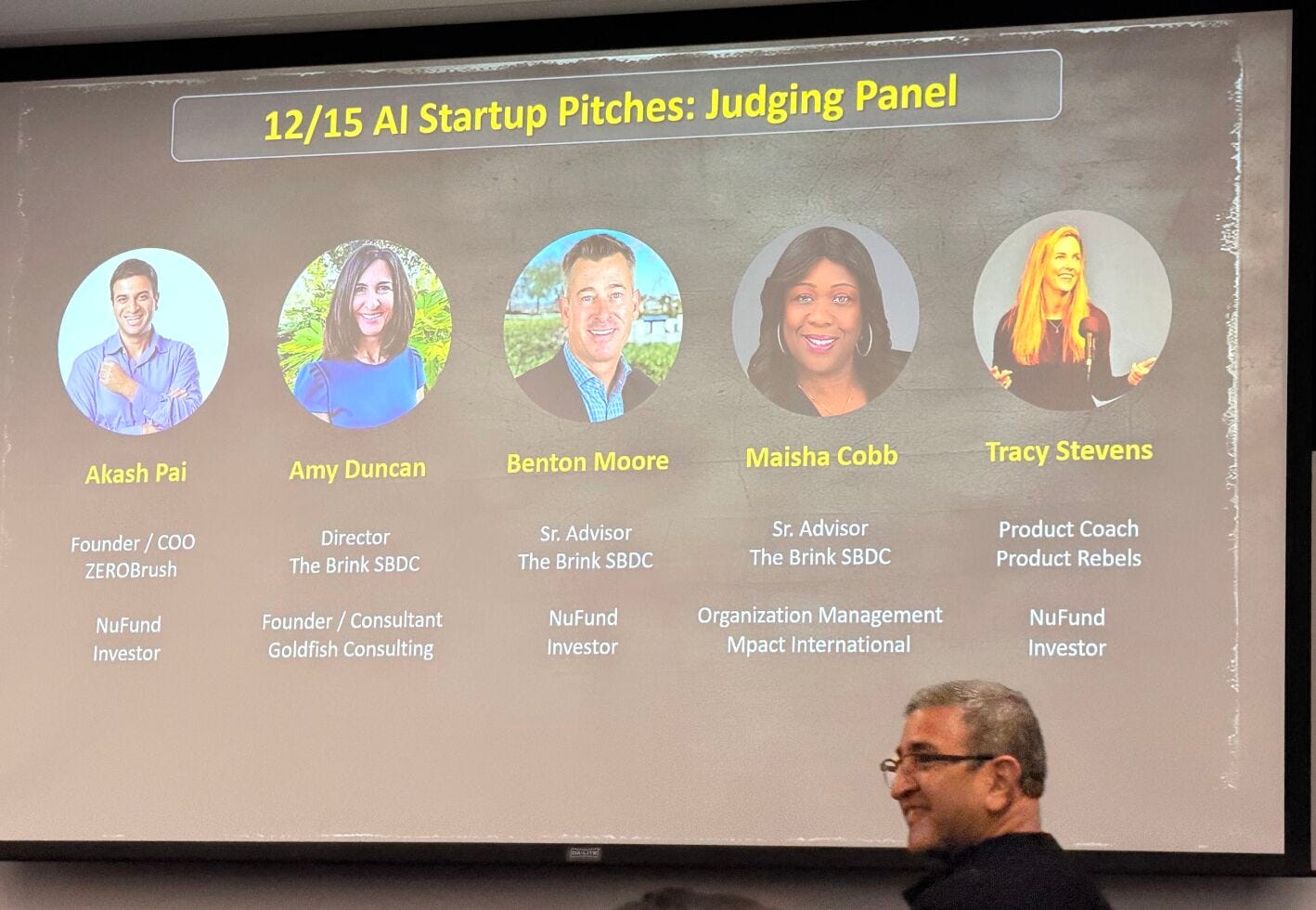
Akash Pai of ZERObrush, Amy Duncan, Benton Moore, Maisha Cobb, PhD, MBA of The Brink SBDC, and Tracy Stevens of NuFund Venture Group consistently pushed founders on the questions that matter most at this stage: where traction is real, where distribution is still unproven, how adoption actually happens inside constrained workflows, and what evidence needs to exist before scale capital makes sense. Across pitches, a common theme emerged—AI only creates value when it is tightly integrated into real-world behavior, incentives, and decision-making.
Several companies stood out for how clearly they framed real-world problems and defensible solutions.
Mood Ring AI, led by Lillian Wool, addressed one of the most persistent challenges facing distributed organizations: understanding and supporting employee sentiment without invading privacy. The company positioned itself as a context-aware, privacy-first “Grammarly for HR,” helping teams proactively identify cultural risks before they turn into attrition or disengagement. The pitch stood out for clearly framing the cost of reactive people management and for presenting AI as a supportive layer rather than a surveillance tool—an approach that resonated strongly with both investors and audience questions.
Athletech®, founded by Andre Buchanan, delivered a compelling example of founder–market fit. Drawing directly from his background as a player and coach, Buchanan framed the significant cost and access barriers in youth baseball development. Athletech’s platform uses AI to convert standard 2D swing video into detailed 3D motion analysis, making elite-level feedback accessible to a much broader population. The pitch combined personal credibility, meaningful traction metrics, and a differentiated technical approach, clearly demonstrating product-market fit.
Venn, represented by Zed Truong, Aidan Scudder, and Gedeon Baende, reframed loneliness and member churn as a measurable economic drain rather than a soft, abstract issue. The team presented Venn as a community-driven platform designed to increase belonging, engagement, and retention—particularly for organizations where connection directly impacts outcomes. Backed by a 5,000-member community and multiple live pilots, the company demonstrated both demand and early validation, grounding an emotionally resonant problem in hard metrics.
Mira AI, led by Dee Narla, focused on the growing burnout crisis facing nurses and frontline clinicians. Rather than attempting to replace or overhaul existing systems, Mira positions itself as a nurse-first voice documentation tool that layers simply on top of complex EHR infrastructure. The pitch emphasized empathy, workflow realism, and ease of adoption—highlighting how even small reductions in documentation burden can materially improve retention, morale, and patient care.
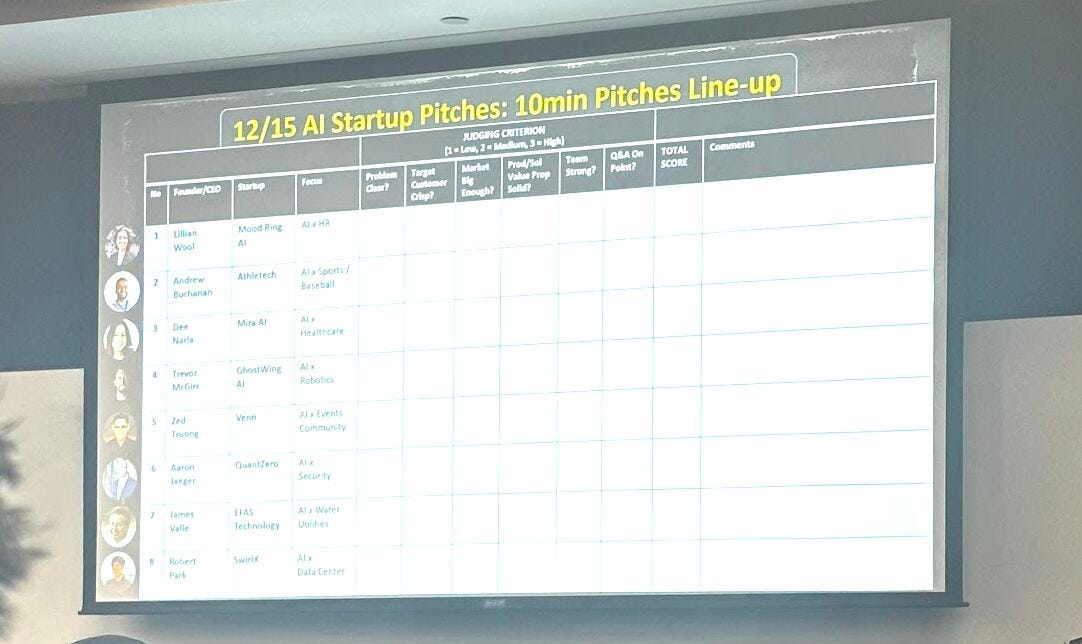
Ghostwing AI, presented by Trevor McGirr, tackled defense from a safety-first perspective: keeping soldiers out of harm’s way. The company distinguished itself by emphasizing autonomous, reasoning-driven drone swarms that go beyond improved hardware or vision systems. Ghostwing’s focus on on-board cognition and coordination positions it at the frontier of autonomous defense systems, with a clear narrative around mission relevance and operational advantage.
QuantZero, led by Aaron J., translated zero-trust cybersecurity theory into a concrete, buyer-ready framework. By tying the problem to a quantified $12 trillion global risk and using clear visuals and maturity scoring, QuantZero turned an abstract security concept into an actionable roadmap for enterprises. The pitch stood out for its clarity, making a complex risk landscape understandable and operational for decision-makers.
EFAS Technologies, represented by James Valle, addressed global water security and leakage—an increasingly high-stakes issue for governments and large organizations. EFAS positioned itself as a software platform that enables monitoring and mitigation using existing infrastructure, avoiding the friction and cost of new hardware deployment. The company differentiated with models that function effectively on limited data and reinforced credibility with proof points from international pilots already in operation.
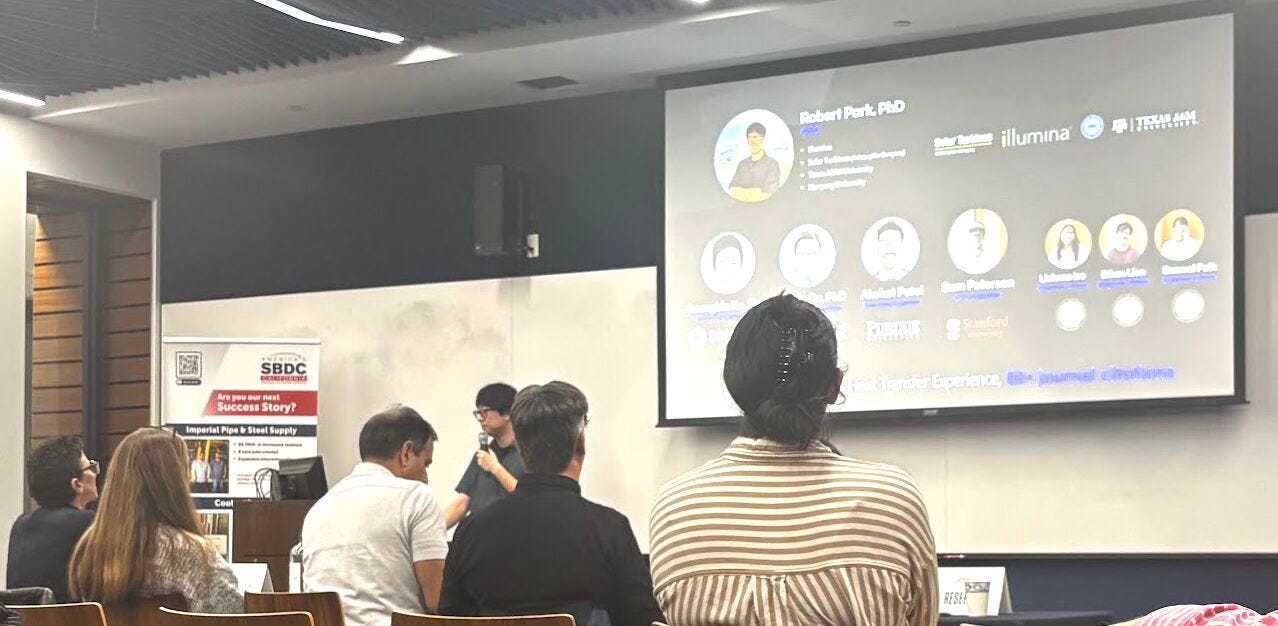
SwirlX, led by Robert Jaehyung Park, connected AI’s rapid expansion to a less-discussed but critical bottleneck: inefficient heat exchangers in industrial and data infrastructure. SwirlX applies advanced modeling and optimization to significantly improve thermal efficiency, delivering measurable energy savings and large-scale cost reductions. The pitch effectively linked a technical innovation to urgent infrastructure and energy constraints facing AI-driven growth.
Across a cohort spanning healthcare, defense, cybersecurity, climate, infrastructure, and community platforms—with dozens of active pilots and real customers represented—what stood out most was discipline. These founders were not pitching speculative futures; they were presenting constrained environments, clear buyers, and realistic paths to scale. Equally notable was where AI wasn’t used—teams demonstrated restraint, deploying automation only where it improved trust, outcomes, or efficiency.
The academic setting mattered. USD provided a neutral, rigorous environment where ideas could be sharpened before meeting the market at full speed—bridging applied research, operator insight, and investor perspective in a way that early-stage companies benefit from disproportionately.
From a long-term capital perspective, what stood out wasn’t hype—it was execution. Clear problem definition. Evidence of demand. Thoughtful use of AI where it actually moves the needle.
At Del Mar Medical Pensions, we spend our time thinking about durability—how capital compounds over decades, not quarters. Events like this are encouraging because they reflect that same mindset: founders building practical solutions, for real customers, in markets where trust and adoption matter.
The next chapter for these teams will be proof velocity—turning pilots into contracts, usage into retention, and clarity into scale. With this level of execution, feedback, and community behind them, they are well positioned to turn strong ideas into durable, category-defining companies.
With this level of execution, feedback, and community behind them, these teams are well positioned to turn strong ideas into durable, category-defining companies.