
Triple Retention: How a Defined Benefit Plan Becomes a Strategic Advantage
“A defined benefit plan isn’t just a retirement tool — it’s a cultural commitment,” says Robert Mowry, Partner at Del Mar Medical Pensions.
“When employees see a guaranteed retirement benefit accumulating on their behalf, it changes how they view their employer. It shifts the relationship from transactional to long-term partnership. That alignment is what drives retention.”
Employee retention is no longer just an HR issue — it is a balance sheet issue. Recruiting costs, onboarding time, lost productivity, and cultural disruption compound quickly when turnover rises. For organizations with long training cycles or client-facing roles, the real cost of losing a team member can exceed 1–2x their annual salary.
A properly structured defined benefit (DB) pension plan can materially change that equation.

Why Retention Improves Under a Defined Benefit Plan
Unlike a 401(k), which shifts responsibility and market risk to the employee, a defined benefit plan provides:
A guaranteed retirement benefit formula
Employer-funded contributions
Predictable long-term value
Strong psychological anchoring
Employees do not just see “an account balance.” They see a future income stream tied to tenure.
That distinction matters.
1. Golden Handcuff Effect — Without Toxicity
Defined benefit plans often use vesting schedules (e.g., 5-year cliff vesting). Employees understand that staying longer materially increases their retirement value. This encourages commitment without requiring restrictive employment contracts.
2. Perceived Stability
When an employer offers a pension, it signals:
Financial strength
Long-term planning
Institutional seriousness
This enhances trust and reduces flight risk.
3. Meaningful Wealth Accumulation
For younger employees, consistent annual contributions compounded over decades can project significant retirement income. That future value becomes increasingly costly to abandon.
Why Retention Can Triple
In industries with traditionally high turnover, retirement benefits are often minimal or entirely self-funded.
When one employer introduces:
Employer-funded pension contributions
Professional investment management
Structured vesting
they become structurally differentiated.
Employees compare offers not just on salary, but on total long-term compensation.
A pension changes the comparison set.
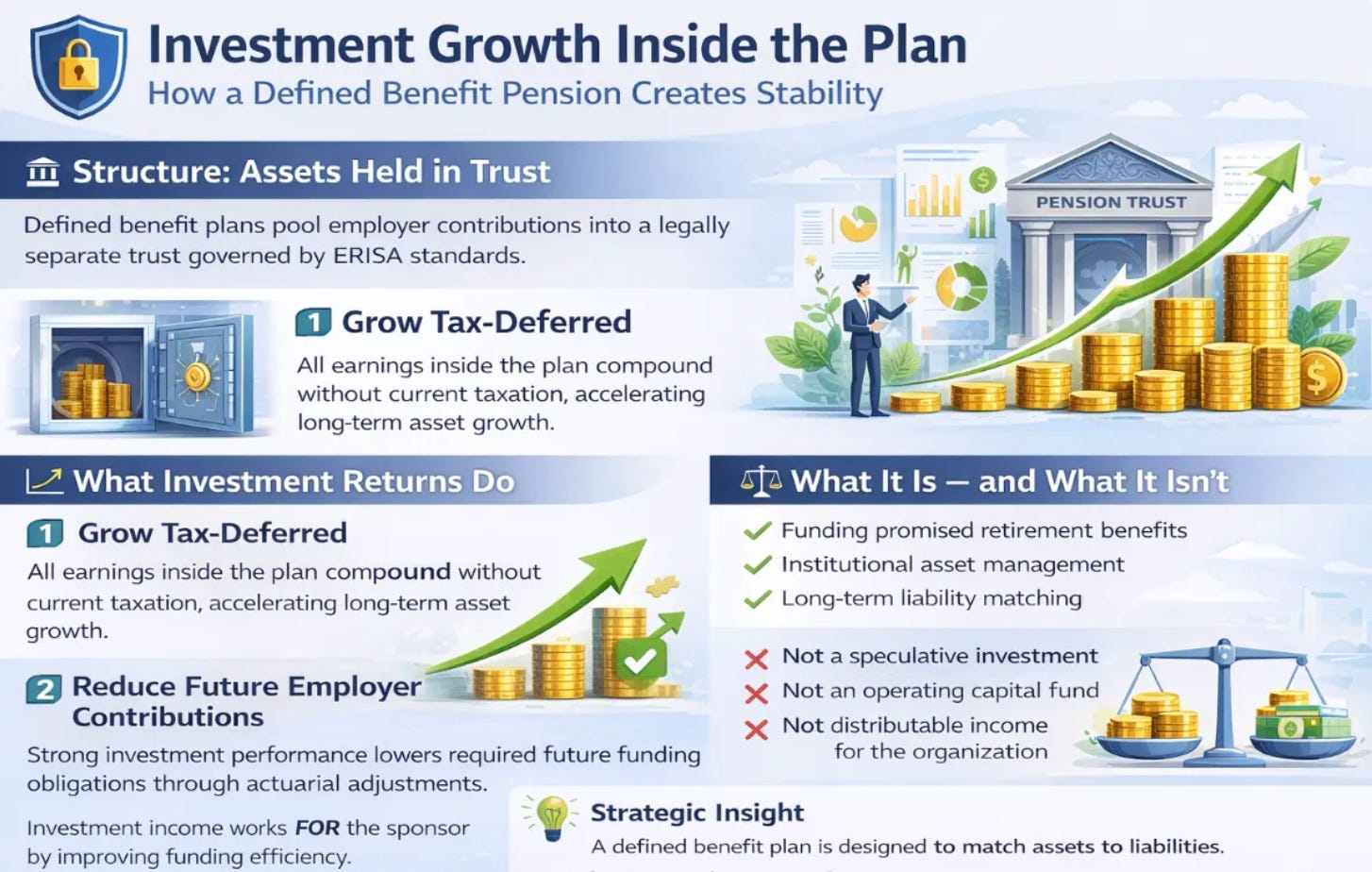
Investment Growth Inside the Plan
Defined benefit plans pool assets in a trust and invest them under ERISA standards. Investment returns:
Grow tax-deferred
Reduce future employer funding requirements
Support long-term benefit sustainability
The organization is not speculating for profit — it is funding promised benefits — but disciplined investment strategy can materially improve funding efficiency.
When well-managed, investment income becomes a stabilizer rather than a risk amplifier.
Strategic Benefits to the Organization
Beyond retention, a defined benefit plan offers:
Larger deductible contributions compared to defined contribution plans
Executive benefit design flexibility
Enhanced recruiting power
Structured long-term capital allocation
For nonprofit housing corporations, professional associations, or closely held entities, this can elevate governance and financial discipline.
Important Guardrails
A defined benefit plan must:
Follow ERISA requirements
Avoid prohibited transactions
Maintain proper actuarial funding
Separate plan assets from operating funds
It is not an endowment or investment pool for general operations. Assets belong exclusively to the plan participants.
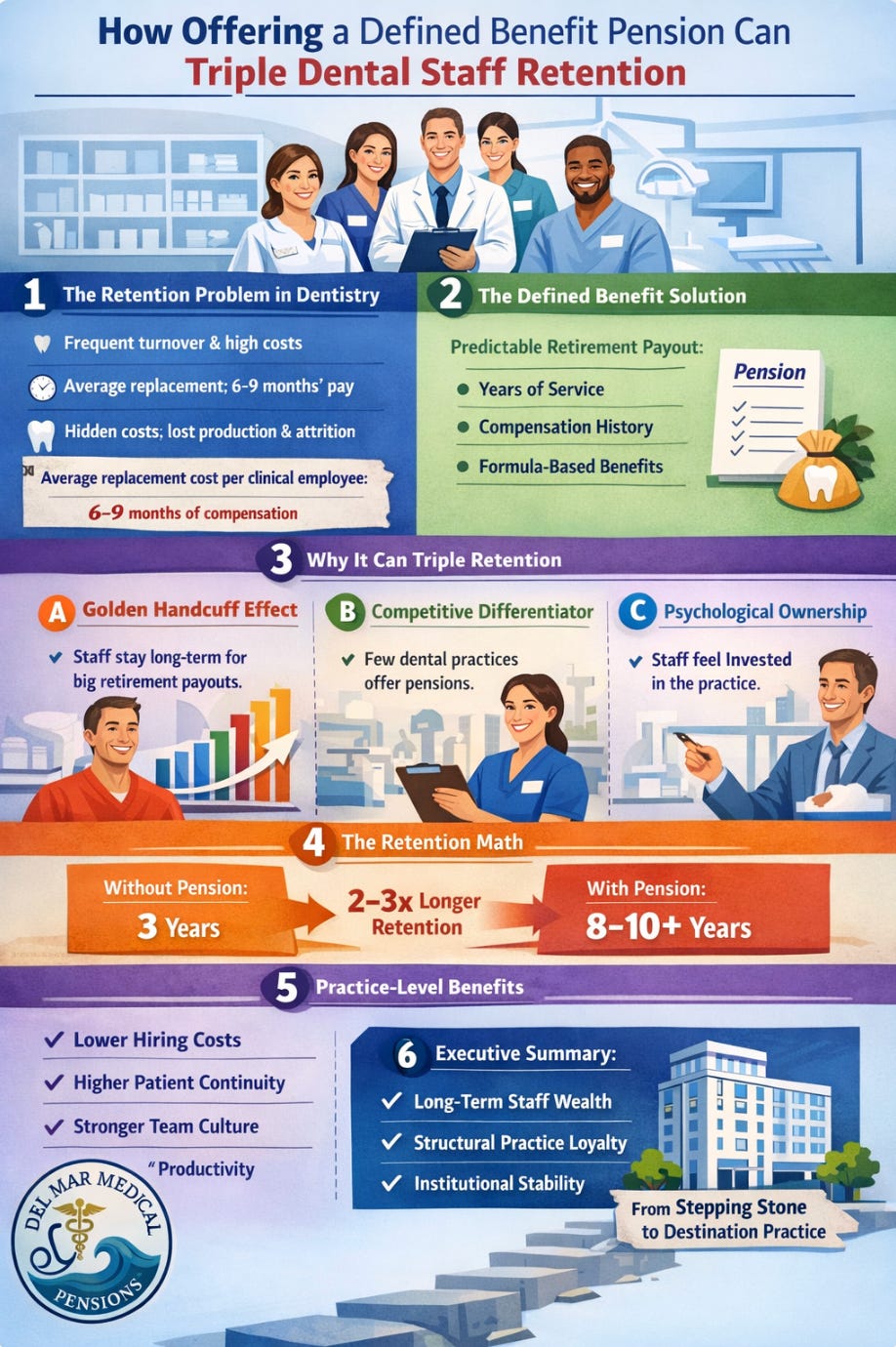
Retention improves when employees believe:
Their employer is stable.
Their future is supported.
Staying is financially rational.
A defined benefit pension aligns all three.
In competitive labor environments, salary alone rarely creates loyalty. A pension creates long-term alignment — and that alignment can materially reduce turnover, improve culture, and strengthen institutional continuity.
Retention is not just about keeping people.
It is about building something worth staying for.