
From Lagos to the Lab: How a UC San Diego Surgeon Is Reinventing Vascular Care, AI, and Medical Devices
“In this episode, Dr. Ross shows how seamlessly surgery, AI, and practical innovation can come together—precisely the kind of impact that moves our ecosystem forward.” —Robert Mowry, Partner, Del Mar Medical Pensions
At UCSD, Dr. Elsie Ross stands at the intersection of surgery, data science, and medical innovation. As an Associate Professor of Surgery in the Division of Vascular Surgery, she splits her time between the operating room and a research lab focused on artificial intelligence and cardiovascular disease. Her story weaves together immigrant determination, academic perseverance, a deep understanding of underserved patients, and a practical drive to fix what’s broken in the health system—whether it’s a diagnostic gap or a flawed medical device.
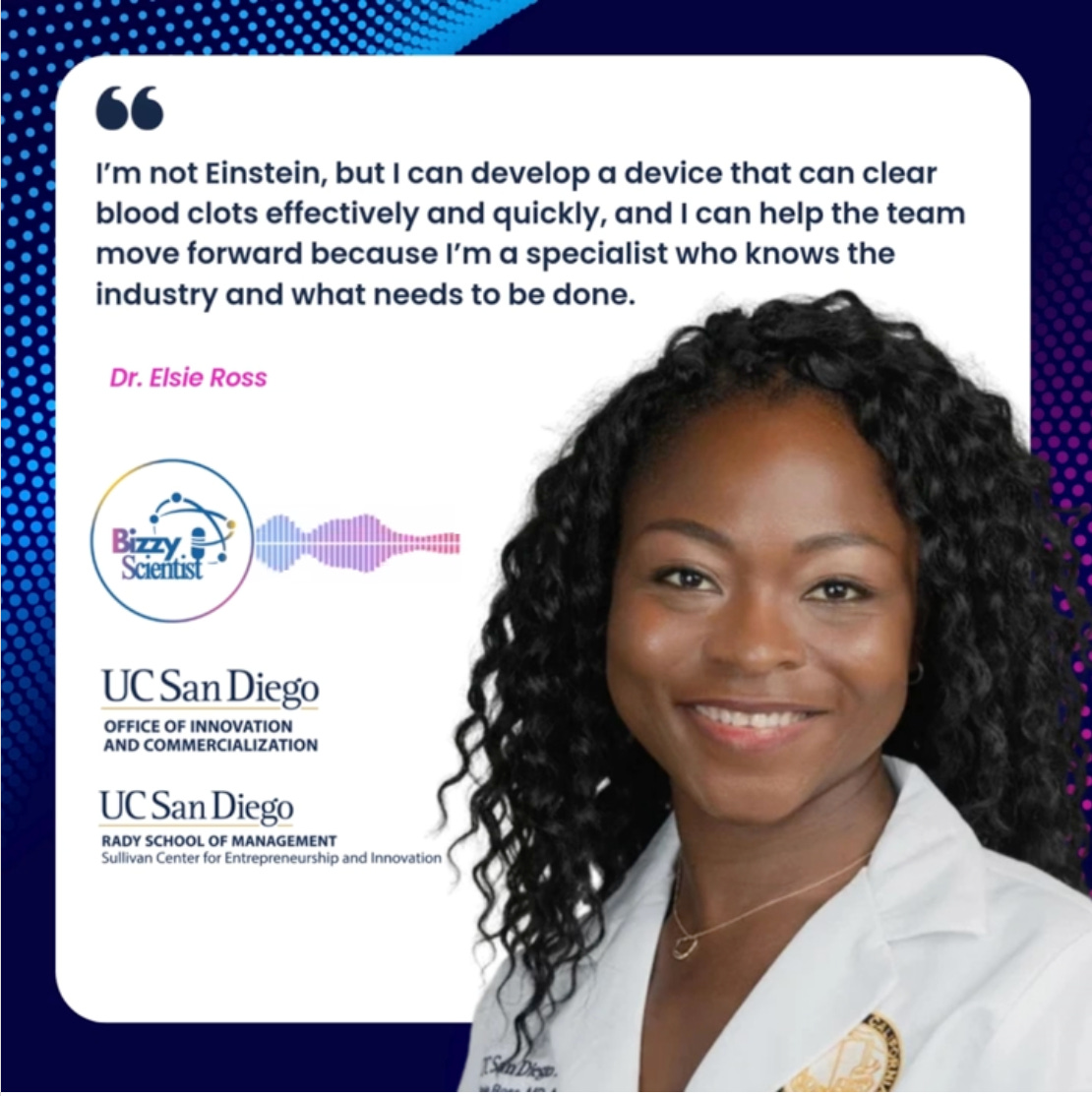
Here are some of my favorite parts from her podcast interview with Nora.
A Personal Path into Medicine
Dr. Ross’s path to medicine began long before medical school. She was born in Nigeria and moved to the United States at age three, growing up in New York in a single-parent household with significant financial hardship. Her family was deeply affected by sickle cell disease; she saw relatives struggle and die from the condition, and spent significant time in and around pediatric care.
Out of that environment came two parallel ambitions:
To become a doctor who could help patients like her family members.
To become a scientist who might one day help cure diseases such as sickle cell.
Her early years in the U.S. were shaped by public schools that were not particularly well resourced. What made the difference, she recalls, were teachers who recognized her talent and invested extra time and attention in her education. Combined with her own drive, this support accelerated her academic trajectory: she finished high school early, started college at 16, and was accepted to Stanford University.
At Stanford, the transition was not seamless. Coming from a modest public-school background, she wasn’t as academically prepared as many of her peers and struggled initially. Freshman year was especially difficult, both socially and academically. But mentors and professors again played a pivotal role, helping her adapt her study habits and refine how she learned and retained information.
She also made a deliberate decision not to rush her pre-med requirements, choosing instead to take courses in writing, history, sociology, and psychology—subjects that would later shape how she thinks about patients as people, not just cases. Only after finishing that broader education did she return to the remaining pre-med coursework and apply to medical school.
How Mindset, Mental Health, and Empowerment Shape Cardiovascular Outcomes
Today, Dr. Ross treats vascular disease, much of which sits at the intersection of biology and behavior: genetics, diet, smoking, exercise, and broader social conditions. But she emphasizes that mental health and a patient’s sense of empowerment are just as important.
Research has long shown that depression increases the risk of cardiovascular events such as heart attacks and strokes, and affects how likely patients are to take medications, attend appointments, or follow through on lifestyle changes. In her own vascular practice, she sees this reflected in higher rates of amputations and complications among patients who are struggling psychologically or who feel powerless.
Dr. Ross stresses that this isn’t only about clinical depression. Many of her patients from underserved communities carry a worldview shaped by persistent poverty, systemic barriers, and years of feeling ignored by institutions. They may be cheerful or outwardly “fine,” yet deeply believe that nothing they do will change their circumstances. In that context, advice like “don’t smoke” or “go exercise” can feel abstract or pointless.
Having grown up in similar circumstances, she recognizes this mindset intimately: the sense that life happens to you, rather than with you or through you.
Her work with these patients goes beyond procedures and prescriptions. Because vascular disease is chronic and patients are followed over many years, she has repeated opportunities to build trust and slowly foster a sense of agency. Outcomes are mixed—some patients gradually engage more deeply and take better care of themselves; others never fully shift their outlook—but she views this long-term engagement as an essential part of her role.
She also argues that the healthcare system could do much more to incorporate psychological assessment and empowerment into routine care, not only in primary care but in specialties like surgery where clinicians maintain ongoing relationships with high-risk patients.
From Pediatrics to the Operating Room: Becoming a Surgeon–Scientist
Dr. Ross did not initially plan to become a surgeon. For much of her early training she imagined herself as a pediatrician, and at one point even considered a niche path as a pediatric interventional neurologist.
That began to change during her clinical rotations in medical school. After two preclinical years dominated by books and exams, she entered the wards and chose surgery as the first rotation specifically to “get it out of the way.” The reputation of surgeons as harsh, exhausted, and intimidating did not appeal to her, and she did not see herself in that culture.
What she found instead surprised her:
The fast pace and clear decision-making of trauma surgery energized her.
The experience of seeing an abdomen opened in the operating room and watching the bowel move in real time was “completely fascinating.”
A mentor suggested she explore vascular surgery, a field that spans high-stakes emergencies and more routine, lower-acuity procedures.
On her vascular surgery rotation, she encountered a specialty in transition—from large, invasive open procedures to minimally invasive techniques using wires and catheters inside blood vessels. She also met a group of vascular surgeons who had helped build the modern iteration of the field and were generous mentors.
After that, the decision crystallized: she would become a vascular surgeon.
At the same time, she nurtured her long-standing interest in computers and programming. With the support of mentors in biomedical informatics, she spent two years on an NIH-funded training grant (a T32) learning machine learning techniques, data manipulation, and algorithm development. She focused her work on patients with peripheral artery disease (PAD), developing models to identify high-risk patients and predict outcomes.
As she finished her surgical training, she secured NIH career development funding (a K award) and later an R01 grant, formalizing her role as a surgeon–scientist.
Today, her primary research agenda centers on using AI to:
Detect patients with peripheral artery disease who are present in the health system but undiagnosed.
Integrate these tools into clinical workflows, not just publish them.
Study whether earlier identification and intervention lead to fewer amputations, strokes, and heart attacks over time.
She notes that UC San Diego is particularly well positioned for this work, with strong institutional interest in not only building AI tools but responsibly deploying them across clinical care, operations, and even billing.
Rethinking a Billion-Dollar Problem: A New Device for Dialysis Access Clots
In addition to AI, Dr. Ross is leading the development of a medical device born directly out of her weekly surgical practice: a new tool to clear clots from dialysis access.
Patients with kidney failure often require hemodialysis, which relies on a surgically created access point—usually a connection between an artery and a vein (an AV fistula or graft). These access sites are prone to clotting, which can interrupt dialysis and require urgent intervention.
Existing clot-removal devices suffer from two main problems:
High cost, which contributes heavily to already massive spending on dialysis care.
Suboptimal effectiveness or usability in certain real-world scenarios, especially in outpatient or office-based settings.
By examining cost reports for her cases, Dr. Ross realized that the devices she was using made her procedures up to ten times more expensive than those of a colleague who used simpler tools. Given her background in health economics, this discrepancy troubled her—especially considering that Medicare alone spends roughly a billion dollars per year dealing with dialysis access complications, against a broader dialysis bill in the tens of billions.
At UC San Diego, an opportunity arose when a mechanical engineering course invited clinicians to propose real-world problems for student teams. Dr. Ross and a colleague submitted the idea of a more cost-effective, more reliable thrombectomy device for dialysis access. A student team selected the project.
Over two quarters, working closely with Dr. Ross, the students:
Prototyped a device intended to be both cheaper and more effective than the existing options.
Designed it with outpatient and office-based use in mind, to avoid hospital-based procedures when possible.
Tested it in a simple bench setting and found it did not suffer from the specific failure modes that had caused a prior commercial device to be pulled from the market.
The prototype, however, was large and relied on a certain amount of “MacGyvering.” The current phase of the project is focused on:
Miniaturizing and standardizing the design for manufacturability.
Building a repeatable test system to objectively measure performance (e.g., how finely it breaks up clot, how well it works in tortuous vessels, mechanical stress and strain).
Iterating on the design and preparing for preclinical testing in animal models (e.g., pig fistula and graft models).
Engaging with the FDA to understand the data requirements and pathway toward human clinical trials.
Parallel to the technical work, Dr. Ross has begun exploring the business side: market sizing, pricing, and go-to-market strategy. Programs like UC San Diego’s Institute for the Global Entrepreneur (IGE), the Office of Innovation and Commercialization, and external resources like the Brink have helped her and her team:
Interview other surgeons and interventionalists to validate the need and refine requirements.
Confirm that size and ease of use are critical to adoption, pushing the team to prioritize miniaturization.
Sketch an initial business model and market penetration assumptions, which now need to be refined with more rigorous data.
She sees this device not as a one-off, but as a starting point for a broader suite of products that could make dialysis access interventions easier, safer, and cheaper.
Culture Change, Burnout, and Sustainable Training
Dr. Ross also reflects on how the culture of surgery has shifted during her career.
Historically, surgical training often celebrated exhaustion and harshness: extremely long shifts, constant call, and an operating room culture where yelling and even throwing instruments were tolerated. Over recent decades, work-hour limits (e.g., 80-hour weeks), wellness initiatives, and changing norms have helped reshape the field. Although long hours and stress remain, it is no longer acceptable for surgeons to routinely abuse trainees or staff.
She emphasizes that this shift is not just about workplace civility. It directly affects patient care:
Sleep-deprived physicians make more errors, a fact documented in the studies that drove work-hour reforms.
Taking care of one’s own mental and physical health is a prerequisite for reliably caring for others.
Other high-stakes professions, like aviation, already enforce rest and fitness-to-work standards; healthcare is slowly catching up.
Personal losses during training, including the suicide of a former colleague, sharpened her awareness of the stakes. She argues that physicians and trainees must either find healthier ways to sustain themselves in medicine or feel empowered to leave if the environment is irreconcilable with their well-being.
A Message to Girls and Future Innovators: Interest Matters More Than Perfection
Toward the end of the conversation, Dr. Ross addresses young girls and their parents directly.
She notes that she once believed she was “bad at math,” and that fields like computer science and engineering were off-limits because they were male-dominated and populated by people who seemed effortlessly brilliant. That perception, combined with cultural messages like “whatever you do, be the best,” can create a constant sense of falling short.
Her counter-message is straightforward:
You do not need to be Einstein or “the best” to meaningfully contribute.
If you are genuinely interested in something—whether it’s surgery, AI, medical devices, or any other field—that interest alone is a valid reason to pursue it.
Your unique background, lived experiences, and perspective shape the problems you see and the solutions you imagine. Those differences are an asset, not a liability.
It is acceptable not to know everything at the start. You can learn, assemble a strong team, and contribute your domain expertise while others contribute business, engineering, or manufacturing skills.
In her own case, she may not be a theoretical physicist or pure computer scientist, but she can help create a device that clears clots more safely and cheaply, and build AI tools that identify patients at risk before they lose a limb.
That, she suggests, is more than enough—and it may inspire the next generation to go even further.